Overview
The goal of this project is to improve upon my previous robotic arm design by making it more robust with FOC control, higher quality joints (featuring cycloidal gear drives), and inverse kinematic algorithms. In order to accomplish this goal, I will first be making a cycloidal gear drive for BLDC motors and implementing a basic control algorithm as a proof-of-concept.
Initial Design
Motor
My initial design was set to have Eaglepower 8308 BLDC KV90 motors due to their pancake design, allowing for more torque since the force is generated farther from the axle, that would be controlled via ODrive S1 FOC controllers. As of the time this project was being done, this would result in a price of $202 per actuator (not even including costs of smaller parts such as bearings, screws, 3D-printed parts, etc.). Due to the pricy nature of this design, and my unwillingness to pay egregious prices, I decided to switch to using smaller, gimbal motors.
These motors are not only much cheaper, but also don’t require as robust of a power sources, and are much more optimal for the use-case of an arm in the context of cooling. Many pancake motors, like the Eaglepower 8308, are designed for large drones, and thus have minimal considerations for cooling because it is expected for the air that is pushed down by the propellers act as a cooling system. However, my project has minimal airflow through the motors so these motors may experience high-temperatures. Gimbal motors, on the other hand, are designed with a higher torque constant (i.e. they require less current for the same torque) so they are able to stay cooler while providing the necessary torques for my robotic arm.
Gearbox
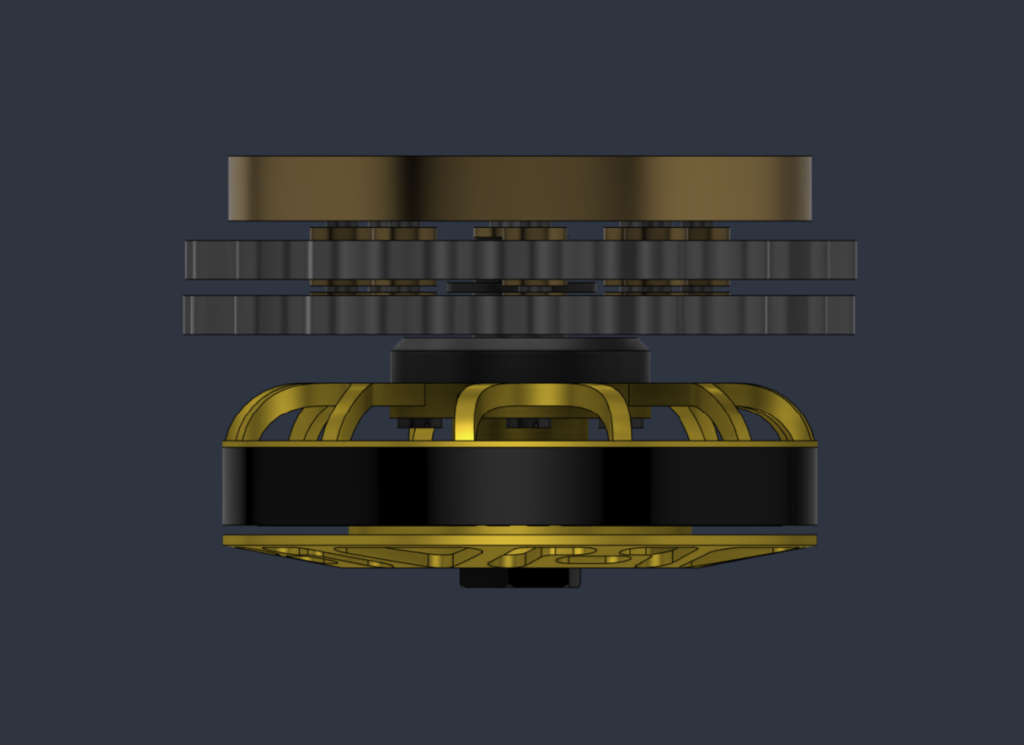
My initial gearbox featured a dual disk cycloidal gear drive with a total width of over 110mm and a total thickness of 35mm (66.6mm including motor). This proved to be overly thick and would prove to be chunky on the future arm. To solve this, using smaller gimbal motors would allow the diameter of the gearbox to shrink drastically. Due to the smaller actuators and overall arm, the load to bear on each motor will also shrink drastically so there is less need print cycloidal gears as thick.